Luke’s gospel is structured by travel. Jesus is on the road for majority of the text, travelling towards Jerusalem. Luke starts sections of his gospel with location and journey markers, and then those sections seem to have an internal (chiastic) structure of their own.
This is the sort of stuff that the geeks get excited by and leaves the ordinary person cold. I think structure is important for two reasons: it shows us beauty and it helps us read texts together. By beauty I mean that the divine and human authors of scripture have collaborated to work literary artistry. The Bible contains some of the cleverest works of human literary endeavour ever produced. By reading texts together, I mean that if the text has natural sections, then that helps us identify some of the ways that the human and divine authors intended us to read different parts of the text in parallel.
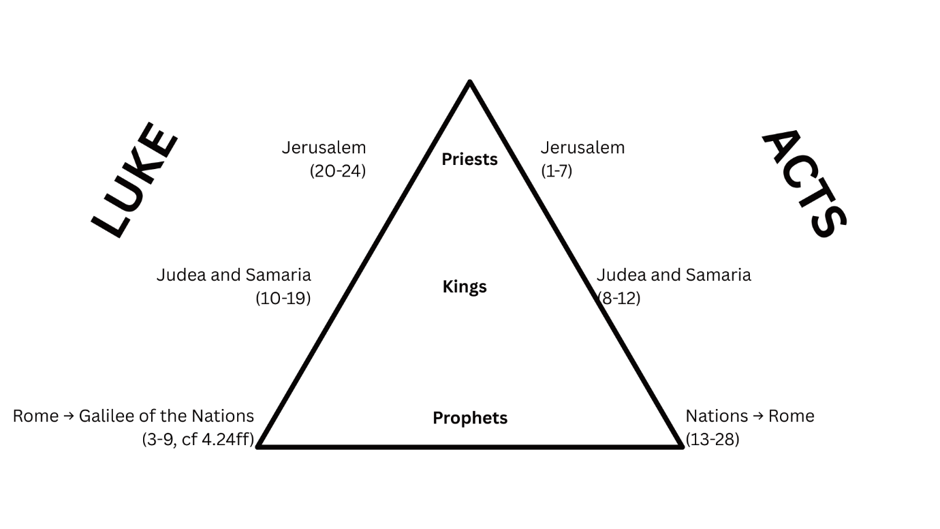
At the THINK conference, Andrew Wilson presented a diagram that looks a little like the below to consider the structure of Luke-Acts.
Andrew observed that there is a progression of places through Luke’s gospel, after the prologue, where John the Baptist is introduced following a string of temporal markers based around the reign of Tiberius Caesar. We start with Rome. Jesus specifically talks about foreigners in 4.24 and following, the widow of Zarephath, Naaman the Syrian, and then Jesus’ ministry is in Galilee. Some of this is Luke’s deliberate attempt to parallel Jesus with Elisha—an ongoing feature in his gospel—but Jesus continues around Galilee until 9.51 when he sets his face for Jerusalem and enters Samaria.
Jesus then travels through Samaria and Judea on the way to Jerusalem until he enters Jerusalem in 19.28. The rest of the gospel is in Jerusalem. That’s particularly interesting when we notice that Acts is deliberately structured the other way around to follow Jesus’ command to go from Jerusalem to Judea to Samaria to the end of the earth. That parallel strengthens the case for Luke’s mentions of Rome in chapter 3 being part of this same picture without Jesus himself going there.
That structure is an interesting feature, not just because it means the early church followed Jesus’ command but also because it means Luke-Acts is structured around death and resurrection, going down/up to Jerusalem and then out into the rest of the world. The reason biblical scholars love chaisms so much is because they’re death and resurrection shaped, meaning the literary structures that the biblical authors have selected to make their points are themselves the shape of the grand narrative of the story they’re telling. There’s also a nice parallel with the threefold nature of the world the first humans were set in (Garden -> Eden -> World) and the commission they were given to take dominion over each area in turn, as well as with the Temple (Courtyard -> Holy Place -> Most Holy Place) which is itself a copy of the cosmos (Earth -> Heaven -> Heavenly Temple or Sky/Heaven -> Heavens Above -> Heavenly Temple/Third Heaven). The world is structured in threes.
Andrew also suggested that this fitted a structure of Prophet -> King -> Priest -> Priest -> King -> Prophet. Certainly in Acts a structure that goes Priest-King-Prophet would be intriguing because that’s the progression of leadership in the Old Testament and so a parallel to its history. It could indicate that Luke is seeing the church as new Israel, and that the church adopts priestly, kingly, and prophetic functions in different ways to Israel.
It’s less immediately obvious to me why a chiastic structure would hold meaning though, and whether Jesus functioning as prophet, king, and priest in that order adds meaning.
Certainly in Acts there’s some evidence of this. If we start with the specific words, then we have a number of priests becoming Christians in 6.7. We have Paul commission in 9.15 to take the word of God to ‘Gentiles and kings and the children of Israel.’ This is the first the converstion of kings are mentioned. However the gospel being told to kings doesn’t start until Acts 25 onwards. Prophets are mentioned pretty evenly throughout, and if we ignore references to Old Testament prophets then we’re looking primarily at chapters 11 and 21, which specifically fits the pattern but I’m not sure it does meaningfully.
If we’re talking more loosely about the function of the church then I think that’s an easier argument. In Acts 1–7, the church operates around the temple in a priestly way. In Acts 8 onwards the church performs a conquest of the nations, a kingly function. This carries on until Paul goes to Jerusalem (Acts 20), where he moves into a prophetic function calling out the actions of kings as Old Testament prophets did. I find that convincing enough, but it doesn’t stack neatly onto the sections Luke has written in and it isn’t confirmed linguistically which would make me want to be cautious in saying Luke intended that we read Acts this way. We can certainly read that way theologically, but should be clear about what we’re doing.
In Luke, I think it’s a harder sell. Certainly, Jesus’ calls himself a prophet in 4.17, and others call him that in Luke 7.16, 26-29; Luke 10.24 carries a reference to prophets and kings together. But, Jesus isn’t called a king until the triumphal entry (19.38), which is really in the Jerusalem section, and most of this various temple discourses and trials in Luke 21–23 hinge on his kingship. Jesus isn’t linguistically cast as a priest. I think the claim that Jesus is functioning primarily as a priest in the crucifixion has weight but needs to take into account the way Luke piles kingly and prophetic references throughout the last week of Jesus’ life.
What might be more convincing is that Luke starts with Jesus as Elisha, portraying him prophetically, but he doesn’t stop doing so, then he introduces a kingly theme—though this comes to fruition in Jerusalem as the city of kings—before adding a rich priestly theme in the crucifixion. By the end of Luke’s gospel these themes are overlapping and rich. Of course, that means they don’t work as structuring principles, but it does mean that Luke has woven the themes together so that when he plays the different registers in Acts we recognise and notice the theme.
Trying to draw that in a diagram would be really complicated.
It’s worthy of further study though, how these different themes are used and played out through Luke and Acts.
Photo by Tim Wildsmith on Unsplash
To subscribe and receive email notifications for future posts, scroll all the way to the bottom of the page.
Would you like to support my work? The best thing you can do is share this post with your friends. Why not consider also joining my Patreon to keep my writing free for everyone. You can see other ways to support me here.

