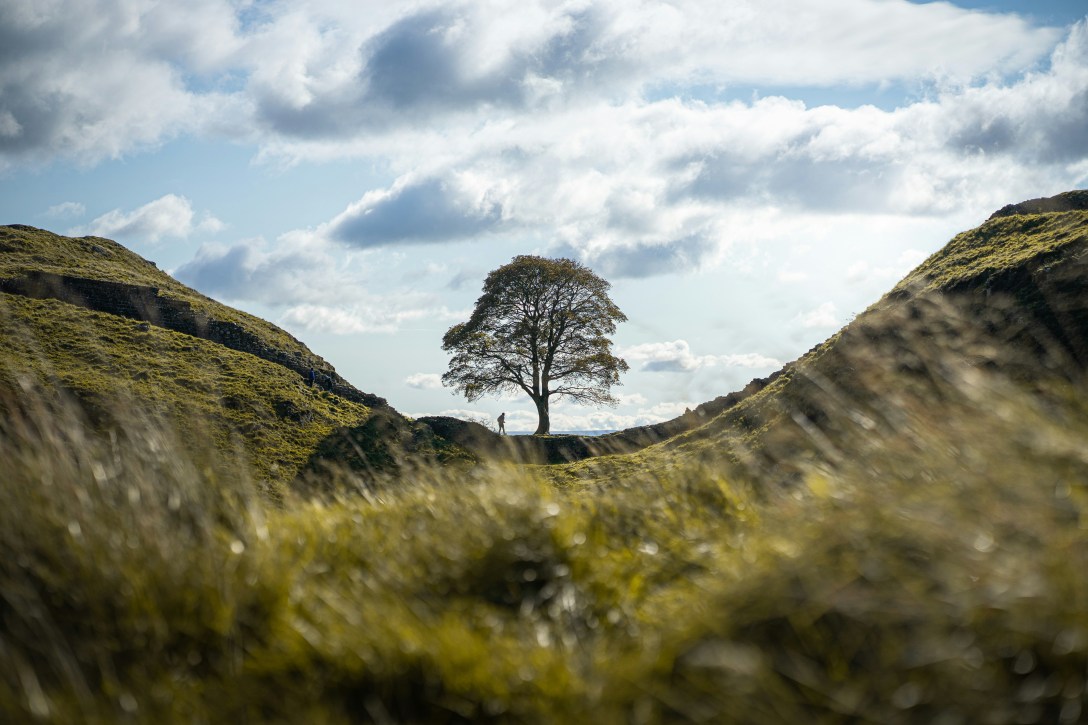
Trees are one of the Bible’s major symbols. We know that because the cross is described as a tree and the Bible is bookended by trees.
If we follow G. K. Beale in thinking that the bookends of the story are important in understanding that story, then Eden and the New Jerusalem are ever before our eyes when reading the Bible. Both are Temples, copies in different ways of the heavenly Temple. The latter is a glorified, expanded, mature version of the former. That means that whenever we encounter temples, trees, mountains, rivers, snakes, seas, fruit or food more widely, we read it in a context of its immediate story but also in a context of the much wider biblical narrative that flows from Eden to New Jerusalem.
Particularly when the cross is described as a tree, we see it as the centre of the story the bookends are the beginning and end of it. We notice a chiastic (death-and-resurrection) shape to the whole story of the Bible. This means whenever I meet a tree in the Bible’s story I expect two things, one I wonder if someone is going to meet with God since the Old Testament’s pattern is one of meeting with God at trees, and two I wonder how it fits into this grander story of the cosmos.
There’s more to the story, of course, not least that we become trees (Genesis 1, Psalm 1) who bear good fruit (Galatians 5, Matthew 7), but that background means that when I meet a tree—especially one described in unusual terms—I wonder why precisely its there and whether that tells me anything.
When working on Luke’s gospel I was reading the story of Zacchaeus in Luke 19, a particular favourite of mine. Zacchaeus climbs a sycamore tree. We can read this historically and consider what kind of tree a sycamore is and how easy it is to climb. We can read this with a simple symbolism and preach the story that Zacchaeus meets Jesus at/in a tree that leads him to repentance much as we meet Jesus at the cross. We can follow Kenneth Bailey in noticing that the crowd who are hostile to Zacchaeus switch their hostility to Jesus (notice the ‘grumbling’) so that Jesus has at this tree diverted their wrath from Zacchaeus to himself: it’s a penal substitution story. I think there’s value in all the above and have preached them myself.
What I want to do is ask ‘why a sycamore?’ Of course, “because it was,” but why are we told it’s a Sycamore? The gospels were composed on codices of limited length meaning sparse language is typical and no words are wasted. Including a word is unlikely to simply be for reasons of reportage so there needs to be a reason that this adds meaning. That can be a historical reason where that detail makes sense, but I didn’t find a particular one on this occasion.
I noticed that the Sycamore (sukomōraia), or the fig mulberry (i.e. not the English tree in the picture at the top of this post), only occurs in the New Testament here (Luke 19.4). In the Old Testament the equivalent tree is the one that Amos tends as his job (Amos 7.14). There might be something in that connection but haven’t found anything that enhances Zacchaeus’ story. So, I looked wider, what other trees does Luke mention?
He mentions the mustard trees in 13.19, but that doesn’t seem especially connected. However, he mentions the Sycamine (sukaminos) tree shortly before Zacchaeus (though, not in the same discrete section of his gospel as I understand it) in 17.5-6. The Sycamine is the black mulberry, used by Jesus in his description of faith because it has a huge root system, but connected to the sycamore both botanically and etymologically. There’s some evidence that sukomōraia and sukaminos were used interchangeably; certainly sukaminos is a transliteration of the Hebrew for ‘sycamore-fig’ rather than the Black mulberry tree.
That doesn’t tell me anything except to wonder if there’s a connection. Then I notice the fig tree (sukē), also botanically and etymologically connected, used by Luke to describe a tree that is lacking fruit (13.6) that the owner gives another year with a bit of compost to see if it can fruit before cutting it down. In 21.29 Jesus tells a parable about fruiting trees being similar to the signs of the kingdom he’s described but specifically points to a fig tree. Luke doesn’t include Jesus cursing the fig tree, and I think these connections might tell us why.
Before we try to explain the various kinds of fig tree, we might just notice that Luke also uses the generic word tree (dendron) in 3.9 where he says that trees that don’t bear good fruit will be cut down, and in 6.43-44 where good trees bear good fruit and figs (sukon) are not gathered from thornbushes: you can know a tree by its fruit.
Jesus uses the image of the tree to refer to Israel, a common Old Testament parallel. Jesus wants Israel to bear fruit, it appears that she won’t, though there’s an element of patience in his ‘mulching’ of the tree in 13.6 not seen in the later cursing of the fig tree—Luke may be expecting his gospel to be a call to repentance for Israel before AD70 so that including the final judgement undercuts that.
Jesus is looking for fruit in Israel. We meet Zacchaeus sat in a fig tree. I think Luke wants us to notice that while Israel is a fruitless tree, there is some fruit, like repentant tax collectors. Zacchaeus is a fig.
There is hope for Israel but it comes in repentant sinners and collaborators rather than through the religious order. The fruit Jesus thinks is worth waiting for is men like Zacchaeus. Since, though Luke doesn’t make this point in the way Matthew does, Jesus is Israel—he is John’s vine and we bear fruit in him—the church should be seen as the society of those that bore fruit in Jesus’ mulching: good fruit looks like the worst of the worst meeting Jesus, eating with him, and never being the same again.
If you find that interesting, this is a summary of part of what I presented at THINK 2026, you can listen to my session here, or find the rest of the conference from there.
Photo by clement proust on Unsplash
To subscribe and receive email notifications for future posts, scroll all the way to the bottom of the page.
Would you like to support my work? The best thing you can do is share this post with your friends. Why not consider also joining my Patreon to keep my writing free for everyone. You can see other ways to support me here.

