Obvious enough, except we’re increasingly wired to treat it like one.
Technologies change the boundaries of what is possible for us and they effect the frame of how we approach the world. If all you have is a hammer, everything looks like a nail. If you also have screwdrivers, you’re able to distinguish the difference between screws and nails. You’re still going to look at a bolt and decide you hit it with a hammer.
New technologies, like new language, redefine the boundaries of our experience of the human life, shifting the centre of gravity of how we approach life and the stories we tell each other. A dominant technology that is adopted extremely quickly, like the social internet or the smartphone, will produce a number of marked shifts in how we think about the world.
We subconsciously expect interactions with other technologies, like books, or other non-technologies, like people, to be similar to these dominant dopamine machines we’ve welcomed into our pockets. Notice, for example, if someone argues in favour of e-books over books not on the basis of portability, but because of searchability. They are assuming e-books are superior to books in one of the areas where they don’t fix a potential downside of books (e.g. it’s heavy to carry five books in your bag) but where e-books fundamentally change the nature of books. Books can’t be searched; that’s not a weakness in the technology, that’s the fundamental nature of the technology. To assume its better to read something shorter or more searchable is to misunderstand what books are for.
That’s the smartphoneification of the book. Or, perhaps more precisely, we could argue using Albert Borgmann’s definition of all technologies as either Instruments or Devices. I’ve written on this before, but to summarise: an instrument is something we use to engage differently with the world, it requires mastery; a device does something for us, and does not require mastery.
Instruments change us but require us to grow in skill to use them. Their formation of us may not always be positive but has much to do with us and our own virtue and virtuous use of them. Devices change us without requiring skill from us. Their formation of us can still be positive but has much more to do with the device itself than with our use of it.
It might be better to describe what I’m talking about as the devicification of instruments. Smartphones are devices. Books are instruments.
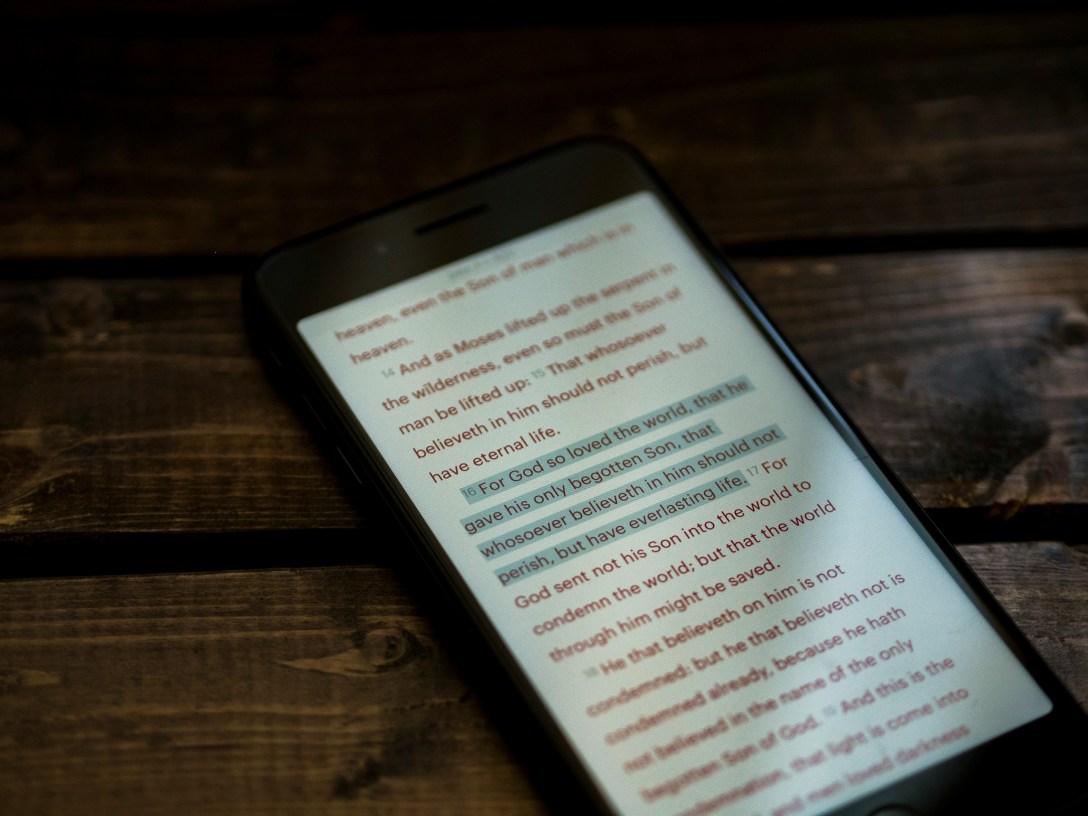
I think we do this with the Bible. On the most superficial level I do mean that we tend to rely on Bible apps on our phones. It’s convenient. It’s searchable. It’s quick. It’s also present on a device carefully designed to hack your central nervous system with the aim of capturing your attention to sell you things. Perhaps pulling that out in gathered worship as we’re expecting to encounter Jesus in the preached word might not be the wisest course? We can just bring our Bibles to church.
I think we do the same thing in much subtler ways too. Do we come to the Bible expecting to find answers provided to us, or expecting to have to work to discover what it would say to us? Do we come to the Bible as though it doesn’t require anything of us to understand, or do we expect to have to change to become the sort of people who can read it? Does the Bible act on our behalf, or do we by the Holy Spirit use the word of God to engage differently in the world?
The first option is treating the Bible as a device, a black box of meaning. The second is treating the Bible as an instrument, something we need to learn and grow in order to be able to wield.
Of course, the Bible is a repository of meaning, it’s the very word of God, but it isn’t a repository in the sense that we’re used to these days. It doesn’t function like your LLM of preference: you can’t ask a question and get an answer. One of the reasons that LLMs can superficially give Biblical answers is because we’re used to people treating the Bible like a device; the reason the AI can’t actually understand the Bible is because it cannot be changed by it.
Not only is getting ‘answers’ shortcutting the important work of becoming the kind of people who read the Bible and learning answers in all their painful glory as we are changed by them, but its also assuming that those answers are understandable without that work. I’m not trying to make the Bible mystical, but it’s not an encyclopaedia. Most of its text is narrative, yes, because the world runs on stories, but also because that’s a method of communicating that takes reflection and time to consider the sense and meaning of what we’re reading and to become the kind of people who are able to read and interpret it.
Instead, we treat the Bible like a device, shying away from things that are challenging or shake our preconceived notions of who God is and how he might act. We want answers to modern questions, rather than reading a book which is going to question us right back.
Photo by Aaron Burden on Unsplash
To subscribe and receive email notifications for future posts, scroll all the way to the bottom of the page.
Would you like to support my work? The best thing you can do is share this post with your friends. Why not consider also joining my Patreon to keep my writing free for everyone. You can see other ways to support me here.
 nuakh
nuakh 