My third and final Bible study question is probably the most mundane. Everyone asks this in our Bible studies.
I imagine my readers here are convinced, as are most participants in a Bible study, that the Bible should in some fashion change us and will have practical applications to us or to the world around us.
The only point I’d like to make in this post is why I deliberately leave it to last. I complained in the first post in this little series about studies that don’t move beyond comprehension. I think this is most common in the ‘Conservative Evangelical’ world (not conservative evangelicals, but the blue shirts and stone chinos guys)—that’s my experience of it, at least. The opposite extreme is more common in the charismatic world, where the only question asked is how to apply it to ourselves (or worse, what it ‘means to me’).
It’s important to apply, it’s important not to apply too fast.
First, we get into the text to understand it and to be made uncomfortable by it. We deliberately face up to the difficulties of it by discussing its strangest features. We invite questions about them and the challenging questions they raise. What we don’t do at that stage, or ever, is judge the text. We allow the text to judge us. We consistently attempt to deal with the Bible on its own terms.
If we do that well, it will unsettle us. It will challenge us. It will change our preconceptions. It will renarrate our stories.
If we apply before we’re unsettled, we will come up with comfortable applications. If we apply before we’ve understood, we will come up with our preconceived applications.
Second, we look to Christ in the text, understanding how to read the Bible as Christians. We do that before we apply because often our applications are not ‘be that guy!’ Instead, they’re ‘Jesus is that guy!’ If we leave it there though we’re left with a richer understanding of the gospel but a poorer understanding of the Christian life. Rather we now read ‘Jesus is that guy and as I’m called to be like Jesus: I should be like that guy in Christ.’
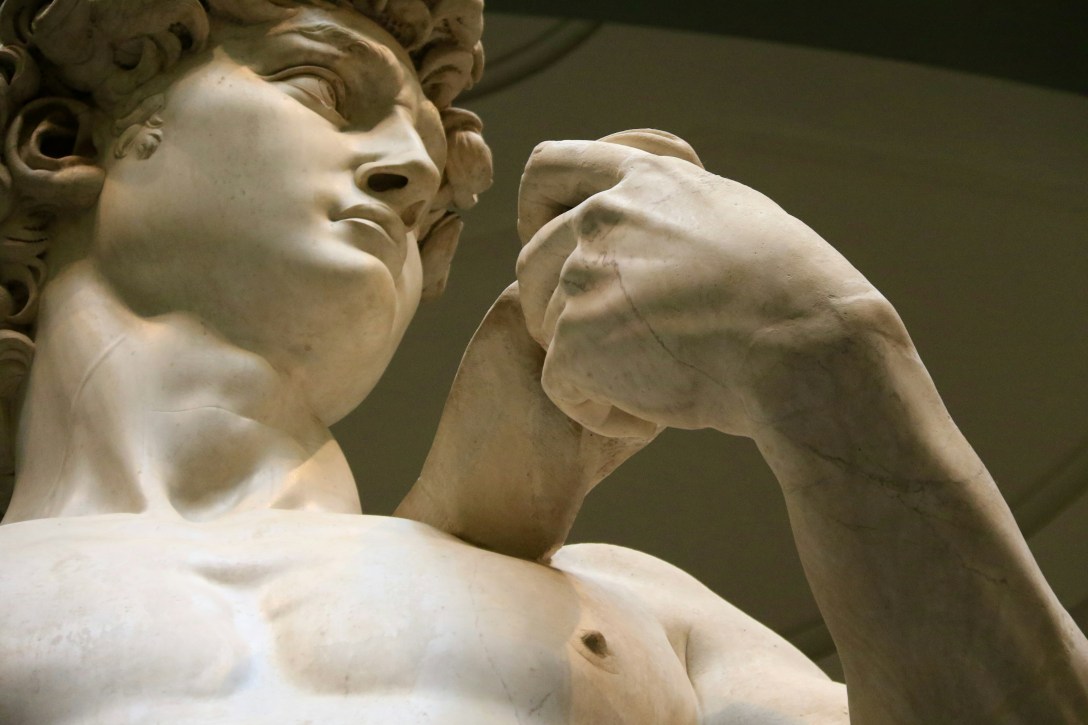
To give the most obvious worked example, are you meant to be David in David and Goliath? Classically this is preached as ‘face your giants!’ We gain practical advice for difficult situations through David’s actions. There can be some wisdom here, but my argument is that it isn’t Christian enough.
Instead, reading Christologically, we realise that we aren’t David but Jesus fights against our snake-skin clothed giants for us. We find in the story Jesus’ defeat of sin and death and the wonder of grace in sanctification. Thank goodness I don’t need to be David; I can’t save myself (cue gifs of Matt Chandler shouting).
Except, I don’t think this is enough of an exegetical move. Because I am in Christ and called to be transformed into the likeness of his character (2 Corinthians 3), I am not David, but in Christ I am. In Christ I can fight giants that Jesus has already fought on my behalf, I can do hard things, I shouldn’t wear Saul’s armour and I do need my five smooth stones. All that wisdom that was mined in the first not particularly Christian piece of exegesis becomes Christian wisdom when read through Christ. We still need to apply it.
Worshipping Jesus for his goodness is an application, in fact it’s our primary application, but that shouldn’t be to the exclusion of other good and right applications.
The Bible will speak to your life.
It’s hard though, to figure out how to apply some particularly strange texts. Our applications, to ourselves, the church, or the world, should arise from the work we’ve already done in questions one and two. We don’t switch our minds off for application, if anything this is the difficult bit. We will need to consider prudence, to learn wisdom, to gather principles, and to discuss the correct recipient for that advice. Sometimes it’s you, sometimes it’s the church, sometimes it’s your workplace or school or town or nation, because the kingdom has come to transform everything.
Photo by Rowan Simpson on Unsplash
To subscribe and receive email notifications for future posts, scroll all the way to the bottom of the page.
Would you like to support my work? The best thing you can do is share this post with your friends. Why not consider also joining my Patreon to keep my writing free for everyone. You can see other ways to support me here.
 nuakh
nuakh 