There are two church leadership offices described in the Bible, the elder and the deacon. Deacons provide material (or operational) support to elders, and the only character qualification that’s distinctive between the two offices is that elders need to be able to ‘teach.’ That tells you something about the distinct thing that elders do.
However, we sometimes get stuck on the terms. I often write about pastors. I mean by this exactly the same thing as I do by ‘elders’ but not everyone uses the terms that way. One of the challenging things is that the New Testament uses three different words to refer to this pastoral office.
First, we have ‘elder’ (presbyteros), sometimes literally ‘presbyter’ though that’s fairly uncommon these days. Clearly, they are in some fashion related to the elders of Old Testament Israel and have something to do with being old.
Second, we have ‘shepherd’ (poimēn), which in Latin is ‘pastor.’ Sometimes people say ‘pastor’ is a made-up word, which is not true, it’s just a word from another language. Clearly, they are in some fashion related to shepherds, often a royal title in Old Testament Israel, and used by Jesus to describe himself.
Third we have ‘overseer’ (episkopos), which is the literal translation, but sometimes its rendered ‘bishop.’ Clearly, there is a connection to overseeing things.
My contention is that these three terms all refer to the same office in the New Testament. This is obviously not agreed on by everyone, but those who like me believe in plural eldership as the biblical form of governance for local churches should be able to agree.
This image from Colin Smothers is a helpful summary of where the terms appear in the New Testament and when they appear alongside the others:
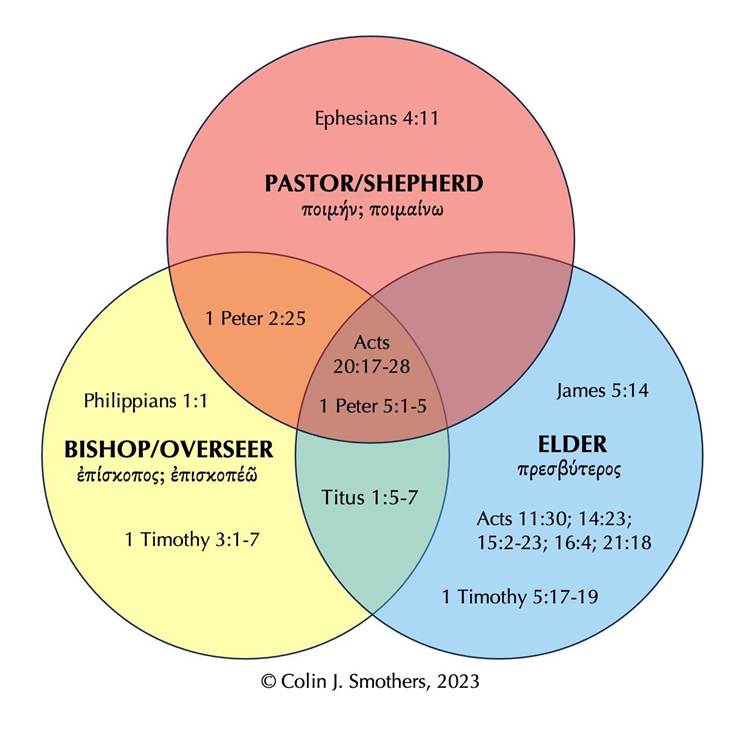
There is an interchangeable sense to their use, it’s certainly not credible that they refer to three distinct offices from each other. To mention just the two passages that connect all three, in Acts 20 Paul is speaking to the elders of the church in Miletus and calls those they serve their flock (pastor) who the Spirit has made them overseers of so that they can shepherd (pastor) them. In 1 Peter 5, Peter writes to ‘fellow elders’ to ‘shepherd’ (pastor) the flock by exercising oversight (overseers).
My church world mostly uses ‘elder.’ I often use pastor partly for historic reasons, partly because that means more to people in other church worlds, and mostly because sometimes using a different term helps us approach things differently. Especially serving for ten years as an elder who had a job rather than one set aside (employed by the church) to devote themselves to prayer and study; sometimes people think that person is ‘the Pastor.’ That’s not our ecclesiology, though it is one some churches use, so I took to referring to myself and my fellow elders as pastors to try and help people understand that we didn’t see a material difference in status, function, or role between ourselves, it’s just that one of us didn’t have to work so had more time.
This is why the term ‘lay elder’ that people sometimes use doesn’t make any sense. I was, in both of those churches, as ordained as the paid guys on the team were. To say ‘lay elder’ is to say ‘non-elder elder’ which is, honestly, a bit offensive to all of those giving 20+ hours a week to their churches unpaid.
(As an aside, before readers get too excited, I appreciate that it is employment in every meaningful way, but I actually think the distinctions of not calling it a job are important so that we get this straight. It’s also vital that paid pastors are treated fairly by employment law. My world tends to have the opposite problem, but people from very different worlds mishear this point because of different kinds of abuse.)
Pastoral Care
This is why the way we use the term ‘pastoral care’ is probably unhelpful. I’m trying to learn to just call it care. There are threads in the complementarian world that want to say that women can be ‘pastors’ because they exercise pastoral care. This usually requires the suggestion that Ephesians 4 is describing spiritual gifts that can be given to everyone, which is in my opinion a misreading. Instead, these gifts are individuals, and it would be strange to think that pastor/shepherd here meant something different to what it referred to in the rest of the New Testament.
Especially if we then think hard about shepherds in the Old Testament, a role of guiding, leading, and taking on enemies rather than a pretty pastoral picture of patting lambs heads (which is not what any real shepherd does anyway), we might start to realise that most of what we call ‘pastoral care’ has little to do with being a pastor/elder/overseer.
Just because someone is offering care or help does not make them a ‘pastor’ in any meaningful way. I think this sort of changing of words is dangerous. I’ve written before about how when we do this sort of thing slowly over a long period of time it changes things. I’ve seen a church essentially smuggle egalitarianism in via referring to women as pastors. Honestly, that phrasing is too evocative, because I don’t think it was a deliberate conscious plan, but evidence of the way a laxness in language can plough furrows in the mind that make it difficult to think differently.
Arguably this argument rather undercuts my desire to use the word pastor, as it’s so associated with an idea of ‘pastoral care’ which is unconnected to the terms in the Bible. It’s now a term regularly used in education to mean caring for someone in difficulty. Perhaps elders (or shepherds… or bishops?) does escape this tendency. I would certainly encourage us to just talk about ‘care’ if that’s what we mean.
Language matters. That’s been a theme I’ve returned to often in my writing. It creates the categories in which we can think. The creation of terms often allows ideas to exist, though it doesn’t always work this way around. I might point to someone like the writer Mary Harrington, who called herself a ‘reactionary feminist’ before she could define it and seems to have memed her system of thought into being. She has consciously started with terms, and she is great at a turn of phrase, and then established the philosophy required for those terms to make sense. The words ploughed a furrow, and then she had to work to use it.
Let’s call our shepherd-elder-overseers that. This isn’t a plea to change language, if you call them pastors in your world, use that. If you call them elders, use that. If you call them bishops then that’s sort of weird but you do you. It’s a plea to be consistent in our language and to use terms in ways that are consonant with the ways the Bible uses them. If you mean something the Bible isn’t discussing, then call it something else.
Photo by Sam Carter on Unsplash
To subscribe and receive email notifications for future posts, scroll all the way to the bottom of the page.
Would you like to support my work? The best thing you can do is share this post with your friends. Why not consider also joining my Patreon to keep my writing free for everyone. You can see other ways to support me here.
 nuakh
nuakh 