Jesus in the Tabernacle VII
We turn to the altar for incense in Exodus 30. This slightly complicates the flow I’d described from inside to outside, as we step back from the courtyard—perhaps with the high priest we’ve just met—into the holy place to a new, third, item.
They are instructed to make a small wooden box of the ubiquitous acacia wood. It should be the same rough shape as the altar out in the courtyard, with ‘horns’ on the top corners of the cuboid. The whole thing is then overlaid with gold and fitted with the rings to fit the poles for carrying it. This box goes right in front of the embroidered veil that sits outside the holy of holies in front of the ark. In essence it will be straight in front of you when you enter, with the lampstand on one side throwing light across to the table of loaves on the other side.
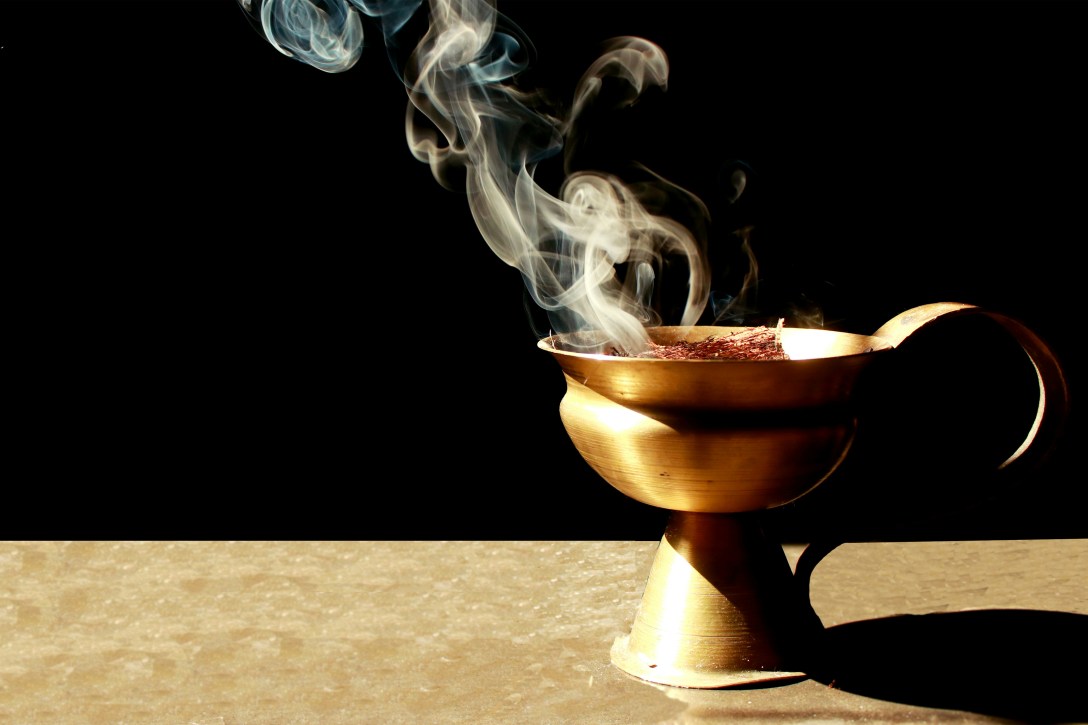
It’s for burning incense on. Every morning and evening when he attends to the oil in the lampstand, Aaron is to burn incense to God as an offering. It’s specific that this altar is only for this purpose, the text stipulating that neither burned, grain, or drink offerings are to be offered on it.
It is to be made atonement for annually, cleansing it with the blood of a sacrifice. Cleansing the tabernacle furniture is an important part of the sacrificial system. Finally, no ‘strange incense’ is to be offered on it. This is exactly what Aaron’s sons Nadab and Abihu do not that long after, and as a result fire from the Lord devours them.
The correct recipe for the incense is given a little later in this chapter. It should be a blend of four spices in equal parts: frankincense, galbanum, onycha—which are all things you can still buy under that name—and stacte, which is probably a kind of myrrh. Three products from plants and one from a mollusc shell. Yes, that is frankincense and myrrh on a gold altar, it is worth noting that all three gifts Jesus is given by the Magi are articles of the tabernacle, but the other spices mess with that symbolism so I don’t think that parallel is as direct as it first looks.
Prayer
In John’s Revelation the prayers of the saints are compared to incense in bowls (Revelation 8). This is a reference to this piece of tabernacle furniture. The incense is supposed to rise to God as sweet aroma, much like the way the smell of burning animals arises to his nose, which is a play on the Hebrew idiom for anger. It seems to represent our prayers and worship. We sing about them as incense often enough.
The logic of Christian prayer is that because Jesus is the great high priest who has passed through the veil of the heavenly most holy place in his ascension, he can plead to the Father for us. We read that he sits at the right hand of the Father to make the earth his footstool (Hebrews 10) and is interceding for us (Hebrews 7). When we pray, our prayers join that intercession that Jesus does for us, lifting us into the inter-dynamic of the Trinity. The Father gives the Son everything he asks for. The Spirit ushers us into that dynamic, perfecting our prayers such that the Father gives the Son what he prays for us. Sometimes that’s not the same as what we prayed, but it is what we needed.
To pray is therefore an act of monumental theological significance. We interact with the mystery at the heart of the Godhead. That interaction looks surprisingly like a conversation with a friend. We chat with God and find it is the most mundane and the most profound thing imaginable. This is often the way: the deep things of God are mundane and ‘earthy’ as well as profound and ‘heavenly.’ We plead with the Father, he will answer the Son’s prayers on our behalf. Except, it’s even more direct than that, you can just talk to God. You don’t have to get the persons straight in your head for him to answer you. You can pray all sorts of nonsense, and for all we ideally wouldn’t do so, the Lord is so kind to his children that he will accept the thing that we should have prayed and says yes to that instead.
To put it more simply: even prayer is a gift from Jesus. Everything is grace. Even our requests are gifts from his kindness. He really is for you.
Worship
Our gathered worship should try and help us see this in some way. Does that mean we need to light incense like some of our much ‘higher church’ brothers and sisters might? No, though you can if you really want to and it won’t set the fire alarms off. I suppose that’s biblical warrant for a smoke machine if you must (don’t). More importantly though is that we raise true incense to God: our prayers and songs of petition and praise.
When I say our worship should help us see it, I don’t mean that we necessarily need a visible cloudy substance. We don’t see that in the worship of the New Testament church, though eventually the church did reintroduce it in their liturgy. I mean that our worship needs to help grant us the transcendence, and the immanence, of what we’re doing. It needs to be heavenly and earthy. I suspect there are several aesthetic ways to achieve this, but we need to aim for both. In my English low church reformed charismatic world I suspect we have ways we’re good at both and ways we’re bad at both. We’re good at demystifying, we’re good at supernatural gifts. We could get better at both. We’re less good at taking things seriously, and we’re less good at making things really ordinary and ‘earthy.’ We can be too chummy sometimes when we’re entering the presence of God, and we can make everything very spiritual when God in the Bible is concerned with very ordinary (and sometimes very graphic) scenes from everyday life.
It’s not about getting the balance right, it’s about both-and. Rarely is ‘balance’ what you want in the Christian faith. I suspect it’s almost impossible to not get this wrong, so the answer is to just keep trying, keep talking to each other, and keep course correcting. Worshipping God is the strangest, and most normal, thing in the world.
Photo by Sayak Bala on Unsplash
To subscribe and receive email notifications for future posts, scroll all the way to the bottom of the page.
Would you like to support my work? The best thing you can do is share this post with your friends. Why not consider also joining my Patreon to keep my writing free for everyone. You can see other ways to support me here.
 nuakh
nuakh 