Over the next eight weeks I’m going to explore the tabernacle in Exodus and the way we find Christ represented in it.
The conviction that this is appropriate comes first, because Jesus is described as ‘tabernacling’ amongst us in the incarnation (John 1), second because he refers to himself as the Temple—a later, larger, developed version of the tabernacle—(John 2), and third because of the overriding conviction that you can and should read all the scriptures as being written about Jesus and therefore they must be read theologically to be about him.
I’ll roughly follow the thread as presented in Exodus 25-30, meaning we go from the inside outwards, starting in the most holy place and its contents: the ark of the covenant.
The Ark
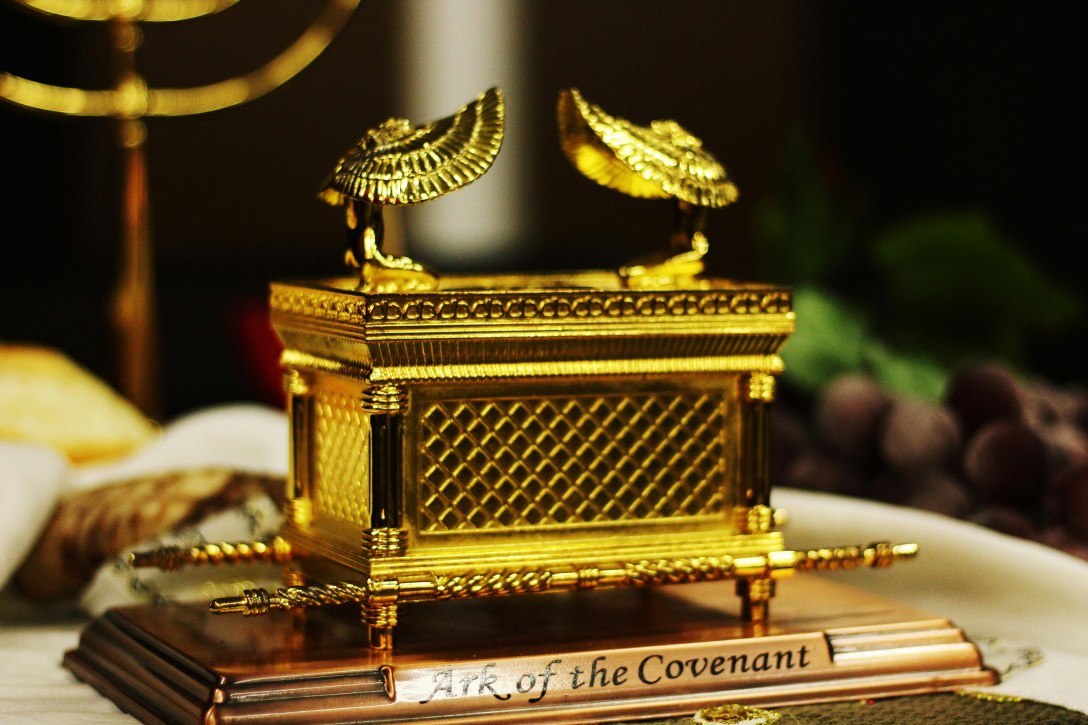
The tabernacle, like the world, is constructed inside out. We start in the middle. The tabernacle is a box within a box (the courtyard). Inside that box is another box, the holy of holies. Inside that box is wooden box with poles that can be carried by men, the box we call the ‘Ark,’ which is a chest. Intriguingly not the same word as Noah’s ark (Or Moses’ ‘ark’ of bullrushes) for all that’s also a really big box.
It’s a touch over a metre long and just under a metre wide. It’s the same height as it is wide. It’s a rectangular box, perhaps the size of the average coffee table. It’s made of acacia wood, which we should think of as ‘tabernacle wood’ as it’s not really used for anything else in the Bible. All the wood, and its poles, are overlaid with gold melted down from offerings freely given by the people. The poles never leave it.
It’s the box inside the box inside the box inside the box at the centre of the cosmos, but it itself is unremarkable. What’s striking is what’s on top of it, and what’s inside it.
The Seat
On top of the ark is a ‘mercy seat,’ which is a special word made up for this thing. The word is linked to the word for atonement; it’s a big plate of gold that sits on top of the golden box to catch the blood on the day of Atonement (Leviticus 16). At either end of the plate of gold are placed golden cherubim, two winged angelic creatures of gold, with wings and the faces of men or other animals. Picture something like a winged Sphinx, they’re common in other ancient near eastern cultures. Their wings reach across the golden plate for atoning blood.
Above them God sits.
This is an image of reality. God sits on a throne borne by angelic creatures (Ezekiel 1). He sits above the place of atonement—he views the world through a rainbow, we’re told, as a sign that wrath points towards heaven—the blood of Jesus ever before him, slain once for all.
This unremarkable box is the place of atonement, is it because of what’s inside it? No, that’s so that the people understand. That’s why it’s called the ark of the testimony: it’s the story box. Make atonement on top of the story, under the presence of God.
That’s still where God sits. At the very centre of things. Above the cross that is the crux of history, and the crux of the structure of all things, on top of the story he told. He is and ever will be crowned in majesty and at the same time the lamb who was slain, the one who came to get us.
We still meet God there. Remembering the story, through the blood of Jesus on the cross, we encounter the living Jesus—and his Father by their Spirit—there to embrace, to love, and to rule.
What’s in the box?
This passage doesn’t mention what’s in the Ark, just describing it as the testimony. Some translations take this to be the tablets of stone given to Moses on Sinai, but the text just says ‘the testimony,’ which I would take to mean all three things we find there.
We can piece this together from Exodus 16, when it describes the Manna, and Numbers 17 when Aaron’s stuff budded and produced almonds. Notice the link to the lampstand. It does appear that the manna and staff disappeared at some point in history before the ark was finally lost (1 Kings 8), which there are a few possibilities for, but we aren’t told the story.
The fullest description is in Hebrews 9. Inside the Ark are the objects of the testimony, the reminders of all God has done. We find the tablet with the ten Commandments, Aaron’s Staff, and a jar of manna.
Or, read with eyes alert to the patterns of the Bible, inside the box we find 10 words of scripture, a budding tree, and a loaf of bread. These are Genesis images, these are Revelation images. These are, I think, three of the most common images in the Bible. A full biblical theology of each would be a book in itself, but these are the images given to Hebrews to remember who they are.
They’re images given to the church, too. The cross is a tree (Acts 5), and we are a people of Bible and Bread (1 Corinthians 10). Our worship is centred around these three things. Jesus is himself the Word of God (John 1), the Bread of Life (John 6), and a new tree that springs from an old dead one (Isaiah 11).
Photo by Igor Rodrigues on Unsplash
To subscribe and receive email notifications for future posts, scroll all the way to the bottom of the page.
Would you like to support my work? The best thing you can do is share this post with your friends. Why not consider also joining my Patreon to keep my writing free for everyone. You can see other ways to support me here.
 nuakh
nuakh 